
AEC300

Atomrock Edge Computing AEC300
AEC300 is Atomrock's compact edge computing platform for real-time perception and physical AI workloads. Powered by NVIDIA Jetson Orin NX with up to 157 TOPS in a 188 × 88 mm fanless aluminum chassis, it brings full Jetson-class inference to space-constrained deployments without sacrificing throughput.
High-performance edge
Up to 157 TOPS
Multi-modal AI fusion
Compact & fanless
High-performance Edge Computing
Powered by NVIDIA Jetson Orin NX (16 GB), with an octa-core 64-bit Arm Cortex-A78AE CPU clocked up to 2.0 GHz and a 1024-core NVIDIA Ampere GPU with 32 Tensor Cores. The same Jetson-class throughput as larger industrial boxes, in a chassis that fits where they don't.
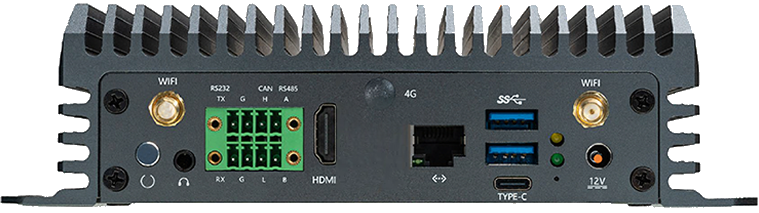
Rich Front I/O
Multi-Modal AI Fusion
Atomrock's AI fusion capability correlates data from vision, audio, thermal imaging, and multiple sensors into a single operational view. Object detection, identification, tracking, and event-driven response all run from one aggregated stream of multi-source inputs in real time.
Multi-Sensor Partner Ecosystem
Atomrock collaborates with AI partners across hardware and sensing domains, including high-resolution cameras, EO/IR imaging systems, optical gas imaging (OGI) cameras, radar, and RF signal detection. The AEC300 ships with the integration APIs to bring all of them under one operational layer.
Compact, Fanless, Always On
An all-aluminum chassis with passive heat dissipation, 188 × 88 × 51 mm and just 0.8 kg net. Wall-mountable for tight installs, wide 9–24 V input for variable supply environments, and rated for 24/7 operation across -20°C to 60°C. CE / FCC / RoHS compliant; built on AtomOS for cloud-native edge management.
Flexible Wireless Expansion
Built-in expansion through M.2 E-KEY (WiFi6 / Bluetooth 5.2), Mini PCIe (4G LTE), and M.2 B-KEY (5G via the same physical socket as USB3.0(1) and 4G, toggleable per deployment). M.2 M-KEY supports expandable PCIe NVMe SSD storage at the bottom of the unit.
Powered by AtomOS 4.0
The AEC300 edge AI platform is powered by AtomOS 4.0, a purpose-built operating system designed with security as a foundational principle rather than an add-on layer. The OS employs a deliberately stripped-down architecture with rigorously screened and whitelisted programs, locked-down ports and protocols, and a strict policy of storing no security-sensitive data locally on the device. All external communications are secured through encrypted connections, while the entire system is hardened from the OS layer upward, creating a significantly reduced attack surface suitable for enterprise, critical infrastructure, and regulated industry deployments.
Secure Provisioning at Scale
Beyond its security posture, AtomOS 4.0 delivers operational advantages through native self-provisioning capabilities that enable secure, automated onboarding and configuration at scale. This allows large numbers of distributed edge devices to be deployed rapidly with minimal manual intervention while maintaining consistent security policies across the fleet. The combination of OS-level hardening, encrypted communications, and streamlined provisioning makes the AEC300 particularly well-suited for organizations requiring both high-assurance edge intelligence and manageable, policy-driven deployment across multiple sites.
Application Scenarios
Nine domains powered by 157 TOPS of on-device AI, from defense and infrastructure to manufacturing and disaster response.
Aerial Threats Defense
Counter-drone perception, classification, and tracking for protected airspaces.
Maritime & Coastal Defense
Wide-area perception across coastal infrastructure, ports, and shoreline security.
Smart City Safety
Citywide camera network analytics for crime prevention, incident response, and public safety.
Infrastructure Safety
Bridges, tunnels, power stations, and other critical infrastructure with continuous monitoring.
Office Management
Access control, occupancy analysis, and incident detection across enterprise facilities.
Energy Management
Substation perimeter security and equipment health monitoring for grid and energy assets.
Manufacturing Defect Inspection
Real-time visual inspection on production lines, catching defects the eye misses.
Gas Leak Detection
Optical gas imaging integration for refineries, chemical plants, and hazardous sites.
Thermal Imaging Disaster Response
Survivor heat-signature detection and hazard visualization for emergency operations.
Specifications
| BASIC SPECIFICATIONS | |
|---|---|
| Module | Original NVIDIA Jetson Orin NX (16 GB) module |
| CPU | Octa-core 64-bit Arm Cortex-A78AE v8.2 processor, up to 2.0 GHz |
| AI Performance | 157 TOPS |
| GPU | 1024-core NVIDIA Ampere architecture GPU with 32 Tensor Cores |
| Memory (Video Memory) | 16 GB LPDDR5 |
| Video Encoding | H.265: 1× 4K@60, 3× 4K@30, 6× 1080p@60, 12× 1080p@30 |
| Video Decoding | H.265: 1× 8K@30, 2× 4K@60, 4× 4K@30, 9× 1080p@60, 18× 1080p@30 |
| Storage | 1 × M.2 M-KEY (expandable PCIe NVMe SSD; supports 2242 / 2260 / 2280; located at the bottom of the device) |
| Power | DC 12V (5.5 × 2.1 mm jack, 9V–24V wide voltage input) |
| Power Consumption | Normal: 8.4W (12V / 700mA) · Max: 32.4W (12V / 2700mA) |
| Size | 188.0 × 88.44 × 50.65 mm |
| Weight | Net: 0.8 kg · With packaging: 1.27 kg |
| Environment | Operating: -20°C to 60°C · Storage: -20°C to 70°C · Storage Humidity: 10% to 90% RH (non-condensing) |
| System Support | AtomOS 3.9.0+, VisionSense AI package |
| AI FUNCTIONS | |
|---|---|
| Advanced AI | Video AI (VisionSense) · Audio AI (AudioSense) |
| Physical AI | Object detection, identification, and tracking across physical environments |
| Customized AI | Scenario-specific AI customization based on application environments |
| Atomrock Integration API | APIs for seamless integration with Atomrock's ecosystem partners and external systems |
| CERTIFICATIONS | |
|---|---|
| Hardware | CE · FCC · RoHS |
| Manufacturing | ISO 9001 |
| INTERFACE SPECIFICATIONS | |
|---|---|
| Internet |
Ethernet: 1 × Gigabit Ethernet (RJ45) WiFi: Expand WiFi / Bluetooth via M.2 E-KEY (2230, internal). 2.4GHz / 5GHz dual-band WiFi 6 + Bluetooth 5.2 4G: Extend 4G LTE via Mini PCIe (internal) 5G: Extend 5G via M.2 B-KEY (multiplexed with 4G and USB3.0(1); M.2 B-KEY is internal and not attached by default) |
| Display | 1 × HDMI 2.0 (4K @ 60fps) |
| Audio | 1 × 3.5mm Audio jack (supports MIC recording, American CTIA standard) |
| USB | 2 × USB 3.0 (Max 1A; UP: USB3.0(1) reused with 5G · DOWN: USB3.0(2)) · 1 × Type-C (USB 2.0 OTG / Debug) |
| Other Interfaces | 1 × Phoenix connector (2×4-Pin, 3.5mm pitch): 1 × RS485, 1 × RS232, 1 × CAN 2.0 · 1 × SIM Card |
| CLOUD / VIDEO / AUDIO | |
|---|---|
| Cloud Connection | AEC cloud connectivity |
| Cloud Recording | Cloud recording with 7 to 366 days data retention |
| AI Events | Cloud retention of AI event logs and snapshots |